NZ's Consent-Free Granny Flats: A Blueprint for Australian Reform?
New Zealand's recent policy changes allow consent-exempt granny flats, built off-site with new materials. Could these progressive NZ granny flat rules inspire similar regulatory reform in Australia to ease housing shortages?
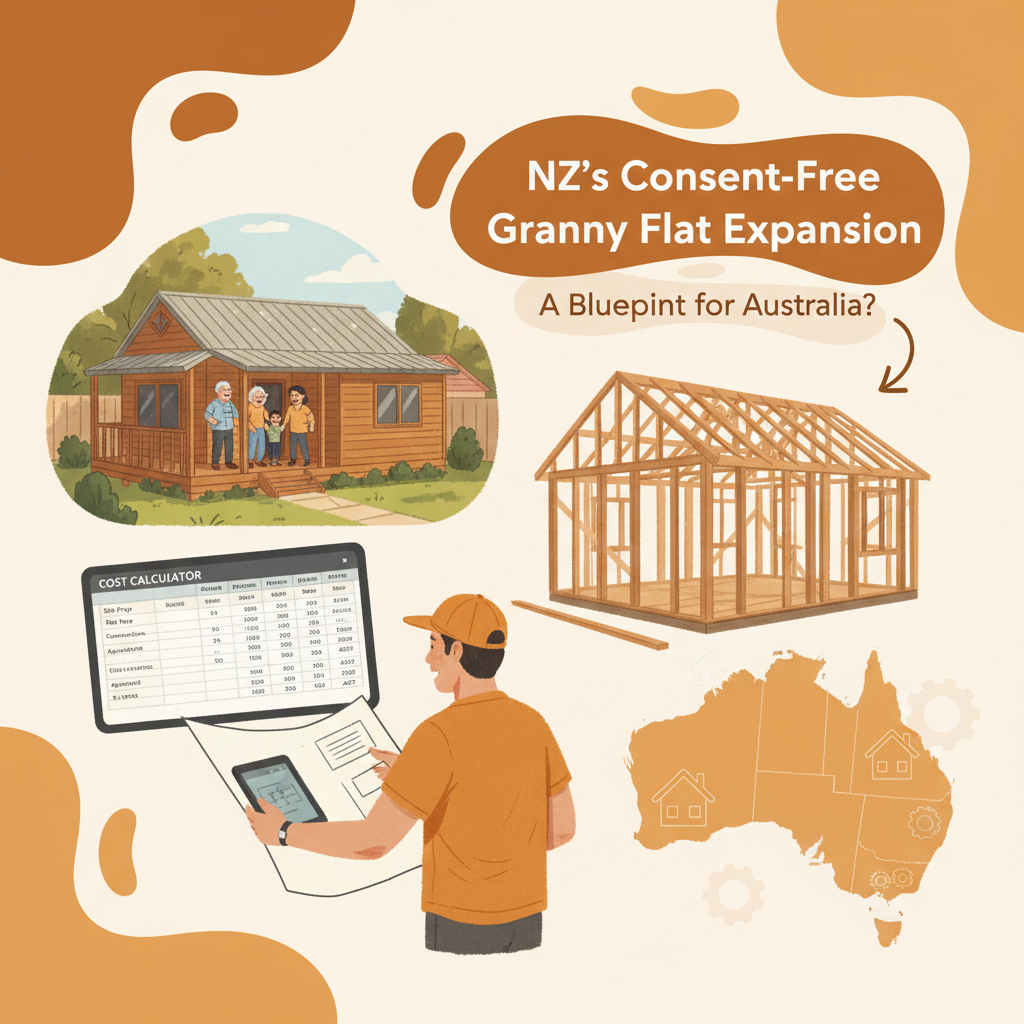
TL;DR: New Zealand’s recent regulatory changes allow consent-exempt granny flats (up to 30sqm) built off-site with innovative materials like Structural Insulated Panels (SIPs). This significantly cuts down on construction red tape. This bold move could offer a blueprint for Australian states aiming to fix housing shortages and reduce the cost and complexity of secondary dwelling approvals.
Key Takeaways
- New Zealand now permits consent-exempt granny flats up to 30sqm, including off-site manufacturing and the use of modern materials.
- This policy aims to accelerate housing supply and reduce building costs and timelines.
- Australia faces similar housing pressures, with states like Victoria and Queensland already exploring significant regulatory reforms.
- Off-site and modular construction offers faster build times, better quality control, and potential cost savings. This makes it highly relevant for future Australian granny flat regulations.
- Australian homeowners should understand current state-specific rules using resources like the GrannyFlatCost State Regulations Guide to figure out approval pathways.
- Expect more streamlined approval processes and wider adoption of modular build types to shape the future granny flat regulations Australia will see.
New Zealand has made a big move to tackle its housing supply issues. They’ve expanded their consent-exempt building rules to include small secondary dwellings. This change simplifies granny flat construction, allowing certain off-site units and new materials, like Structural Insulated Panels (SIPs), without needing full council consent. Australian homeowners and policymakers are watching these NZ granny flat rules closely. They could offer a valuable example for future regulatory reform here.
What are New Zealand’s New Consent-Free Granny Flat Rules?
New Zealand’s recent policy changes mean certain secondary dwellings, commonly called granny flats, can be built without a full building consent. Specifically, the Ministry of Business, Innovation and Employment (MBIE) introduced expanded exemptions in late 2023. These rules allow “cabins, sleep-outs, or tiny homes” up to 30 square metres (sqm) to be built as consent-exempt dwellings, provided they meet specific criteria. This includes units manufactured off-site and those using modern construction methods like SIPs.
This reform aims to cut down on the bureaucratic hurdles and costs involved in adding small dwellings. It promotes faster construction and creates more housing options. These units still need to comply with the Building Code, ensuring safety and quality. But the approval process is much simpler, speeding up development across the country.
How Does NZ’s Approach Compare to Current Australian Granny Flat Regulations?
New Zealand’s consent-exempt approach is quite different from the often complex and varied granny flat regulations you’ll find across Australian states and territories. While Australia has worked to simplify approvals, especially for secondary dwellings, NZ’s model goes further.
In Australia, a secondary dwelling (the legal term for a granny flat) usually needs some form of approval, even if it’s a fast-track process. For example, in New South Wales, granny flats up to 60sqm can often get approval through a Complying Development Certificate (CDC) within 10-20 days, if they meet specific rules. In Queensland, “accepted development” pathways exist for secondary dwellings up to 80sqm in some council areas, which also makes the process simpler. Victoria has also introduced reforms to make it easier to build secondary dwellings, as detailed in our guide on Victoria’s Granny Flat Revolution.
The main difference lies in how much exemption is granted. Australian states aim for fast-track approvals, but NZ’s model, for units under 30sqm, essentially removes the need for formal council permission. This shifts the compliance responsibility to the builder and homeowner, though strict adherence to the Building Code is still mandatory.
Here’s a comparison of key aspects:
| Feature | New Zealand (Consent-Exempt) | Australian States (Typical) |
|---|---|---|
| Max Size | 30sqm | 60-80sqm (e.g., NSW 60sqm CDC) |
| Approval Pathway | Consent-Exempt (Building Code only) | CDC / Exempt Development / DA |
| Construction Method | Off-site, On-site, New Materials | Primarily On-site, Prefab growing |
| Primary Goal | Reduce red tape, increase supply | Streamline approvals, housing diversity |
| Estimated Approval Time | Days to weeks (builder certification) | 10-40 days (CDC/Exempt) / months (DA) |
To understand your specific state’s rules and how they affect your project, the GrannyFlatCost State Regulations Guide offers comprehensive details on approval pathways, size limits, and setback requirements across NSW, VIC, QLD, WA, SA, TAS, NT, and ACT.
Could Australia Adopt NZ’s Off-Site and Consent-Exempt Model?
The idea of consent-free granny flats Australia-wide is certainly appealing, especially with ongoing housing affordability and supply crises. Adopting a model like New Zealand’s could really speed up the construction of affordable housing and increase rental options. The benefits would include fewer planning delays, lower approval costs, and more innovation in building methods.
But putting such widespread granny flat regulatory reform Australia into practice would definitely face hurdles. Each Australian state and territory manages its own planning and building laws, which means regulations are fragmented. Any big change would need serious agreement across state planning departments and local councils. Plus, there’s always a need to balance deregulation with maintaining building quality, safety standards, and community amenity.
Despite these challenges, the push for change is growing. States like Victoria have already made it simpler to build secondary dwellings, showing they’re open to new ideas. The potential benefits for housing supply and affordability make the NZ model a strong example for Australian policymakers to consider.
What are the Benefits of Off-Site Construction and New Materials like SIPs?
New Zealand’s policy specifically allows off-site construction for consent-exempt granny flats, highlighting the clear advantages of this building method. Off-site construction, also known as modular or prefabricated construction, means building components or entire units in a factory. They are then transported to the site for assembly.
Key benefits of off-site construction:
- Faster Build Times: Factories allow for parallel work, cutting construction time by 30-50% compared to traditional site-built methods.
- Cost Efficiency: Controlled environments minimise waste, optimise labour, and prevent weather delays, often leading to cost savings.
- Quality Control: Strict factory conditions and quality checks result in higher precision and fewer defects.
- Reduced Site Disruption: Less time spent on-site means less noise, traffic, and impact on neighbours.
Materials like Structural Insulated Panels (SIPs) are increasingly popular in off-site construction. A SIP is a high-performance building panel used in floors, walls, and roofs. It typically has an insulating foam core sandwiched between two structural facings, like oriented strand board (OSB). SIPs offer excellent thermal performance, which means lower energy bills. Their lightweight nature also speeds up construction. When you’re looking at different build types, GrannyFlatCost’s Build Type Comparison feature can help you understand the realistic total costs for prefab/modular, site-built, and kit home options. This ensures you see a true installed cost, not just an advertised kit price.
How Can Australian Homeowners Prepare for Potential Regulatory Changes?
While Australia considers its own regulatory updates, you can still plan effectively for a granny flat by understanding current rules and future possibilities. The first step is to get familiar with your specific state and local council’s planning scheme.
Here’s how you can prepare:
- Stay Informed: Keep an eye on announcements from your state’s planning department. Reforms can happen quickly, just like in Victoria.
- Understand Current Pathways: Use the GrannyFlatCost Approval Pathway Finder to work out if your granny flat qualifies for a fast-track CDC/exempt development or needs a full Development Application (DA). This depends on its size, your state, and your specific lot. Knowing this is vital for accurately calculating your total project timeline and approval costs.
- Get a Realistic Cost Estimate: Building costs vary a lot by state, build type, and site-specific factors. Our Cost Calculator gives you instant, transparent granny flat cost estimates. These cover build cost, site preparation, utility connections, council approvals, and a contingency for all Australian states and territories. Don’t just rely on advertised build prices; make sure you factor in every aspect, including site preparation and utility connections.
Even as Australia looks for new solutions, thorough planning remains essential. Being prepared for any future granny flat regulations Australia may adopt will put you in the best position to benefit from new, streamlined processes.
Frequently Asked Questions
Are “consent-free” granny flats truly without any approvals in NZ?
No, while they are “consent-exempt” from formal council building consent, they must still comply with the New Zealand Building Code. This means they must be designed and constructed to meet health, safety, and amenity standards. The responsibility for compliance primarily rests with the builder and homeowner.
What are SIPs and why are they relevant to modular construction?
SIPs, or Structural Insulated Panels, are high-performance building panels made of an insulating foam core sandwiched between structural facings. They are highly relevant to modular construction because they are lightweight, strong, offer excellent thermal insulation, and can be assembled quickly. This significantly speeds up construction time and improves energy efficiency.
Which Australian states are most likely to adopt similar consent-free policies?
States experiencing significant housing shortages and with a history of progressive planning reforms, such as Victoria and Queensland, are most likely to consider adopting elements of New Zealand’s consent-free model. These states are actively exploring ways to streamline approvals and boost housing supply.
How do regulatory changes affect granny flat construction costs?
Regulatory changes, especially those that streamline approvals or introduce consent exemptions, can significantly reduce overall granny flat costs. They minimise approval fees, cut down on planning consultancy expenses, and shorten timelines. This can lower holding costs and allow for faster project completion.
Can I build an off-site granny flat in Australia today?
Yes, you can absolutely build an off-site (modular or prefabricated) granny flat in Australia today. These build types are gaining popularity due to their efficiency and quality. However, they are still subject to your state’s specific planning and building approval processes, whether that’s a Complying Development Certificate (CDC) or a Development Application (DA).
The New Zealand example serves as a strong reminder that smart regulatory frameworks can play a big role in solving housing challenges. As Australia continues to face its own housing crisis, the NZ granny flat rules that Australia is watching closely could very well inspire the next big wave of granny flat regulatory reform.
Ready to explore your granny flat options under current Australian regulations?
Calculate Your Cost Free today! Our comprehensive calculator provides instant estimates covering build costs, site prep, connections, and approvals across all Australian states.
Calculate Your Cost Free → https://grannyflatcost.com/calculator
Get your personalised cost estimate
Our calculator covers build cost, site prep, connections, approvals, and contingency for all Australian states.
Calculate Your Cost