Off-Site Granny Flats Get a Boost: Faster Builds Coming Mid-2026
New legislation, expected mid-2026, will allow off-site granny flat construction before approvals. This aims to slash build times and offer more choice for prefabricated and modular options across Australia.
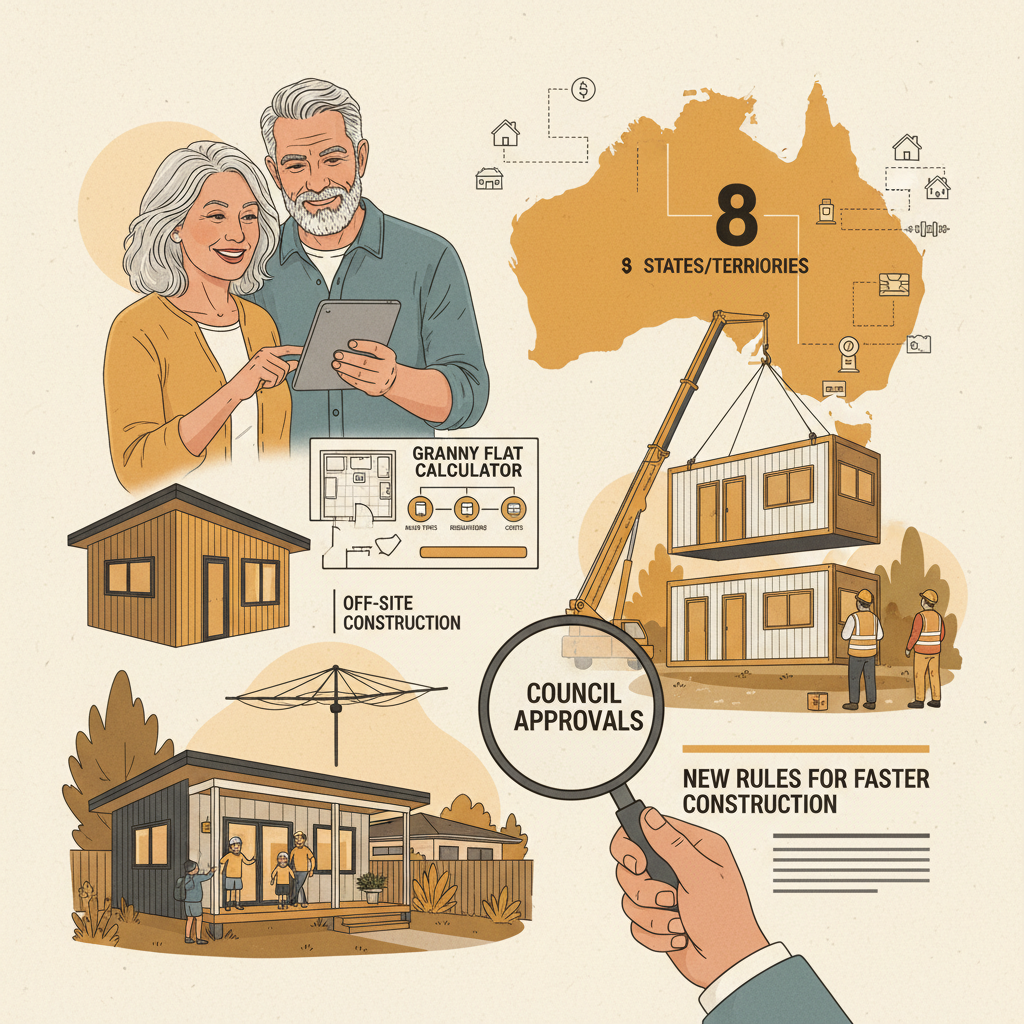
TL;DR: New legislation, expected in mid-2026, will let homeowners start building consent-exempt granny flats off-site before a Project Information Memorandum (PIM) is issued. This reform should significantly reduce overall construction timelines by months, making prefabricated and modular granny flats a much faster option.
Key Takeaways
- Faster Construction: New rules, expected in mid-2026, will allow off-site construction to begin before formal council approval (PIM) for consent-exempt granny flats. This enables parallel processing.
- Reduced Timelines: This shift could cut typical granny flat project durations from 6-12 months down to 3-6 months, depending on complexity and build type.
- Boost for Prefabricated Options: The changes are particularly good for prefabricated granny flats Australia and modular granny flats, making their speed advantage even more pronounced.
- More Predictable Costs: Less on-site time and fewer weather delays with off-site builds can lead to more predictable project costs, though transport and crane hire remain factors.
- GrannyFlatCost Resources: Use our Cost Calculator and Build Type Comparison to understand how these changes impact your specific project and budget.
What Are the New Rules for Off-Site Granny Flats?
The Australian government plans to introduce new legislation, expected around mid-2026, that will significantly change the approval process for off-site granny flats. This reform will allow you to start building consent-exempt secondary dwellings (commonly known as granny flats) off-site even before your council formally issues a Project Information Memorandum (PIM). The goal is to streamline construction and reduce overall project timelines.
Currently, you typically need all council approvals, including the PIM, before any significant construction can begin, even if the building is fabricated off-site. A Project Information Memorandum (PIM) is a planning document from your local council. It outlines key site information like existing services, restrictions, or potential hazards you need to consider during planning and construction. The upcoming changes mean that the factory fabrication of prefabricated granny flats Australia can happen at the same time as the site-specific approval process, rather than one after the other. This concurrent approach is a major step forward for efficiency. GrannyFlatCost’s State Regulations Guide will be updated as soon as these new rules are officially enacted, helping you navigate the altered approval pathways across all 8 states and territories.
How Will These Changes Speed Up Your Granny Flat Project?
These anticipated changes will significantly speed up your granny flat construction by letting you run project tasks at the same time. Instead of waiting months for council approvals before any physical building can start, you can have your off-site granny flat fabricated in a factory while your site preparation, utility connections, and PIM are being processed. This concurrent approach should save significant time off the overall project duration.
For a traditional, site-built granny flat, the typical timeline from initial design to completion can range from 6 to 12 months. This is largely due to sequential planning and construction phases, often compounded by potential weather delays. With the new rules supporting modular granny flats and other off-site options, you could see completion times fall to as little as 3 to 6 months. This faster turnaround not only means quicker occupancy but also potentially reduced holding costs and earlier rental income for investment properties. Our Cost Calculator can help you factor in these time savings into your financial projections, providing instant estimates for build costs, site prep, connections, and approvals.
Off-Site vs. Traditional: Which Build Type is Right for You?
Choosing between an off-site granny flat and a traditional site-built option means weighing several factors, including timeline, cost, customisation, and site disruption. Off-site construction, which includes prefabricated granny flats Australia and modular designs, involves manufacturing major components or entire units in a factory before transport and assembly on your property. Traditional construction involves building the granny flat entirely on your chosen site from the ground up.
The new legislation specifically benefits off-site methods by allowing fabrication to begin sooner, boosting their natural speed advantage. While site-built options offer maximum customisation and are often preferred for challenging sites needing specific adaptations, off-site solutions are great for speed, offer consistent quality due to factory conditions, and cause less on-site disruption. GrannyFlatCost’s Build Type Comparison details the pros and cons, helping you understand the realistic total costs beyond advertised kit prices for each option.
Here’s a comparison to help you decide:
| Feature | Traditional Site-Built Granny Flat | Off-Site/Modular Granny Flat |
|---|---|---|
| Typical Timeline | 6-12 months (sequential process) | 3-6 months (with new parallel approval/build) |
| Cost Range | $150,000 - $300,000+ (highly variable) | $120,000 - $280,000+ (can be more predictable) |
| Customisation | High (fully bespoke designs possible) | Moderate to High (variations on standard modules/designs) |
| Site Disruption | High (long-term presence of trades, noise, waste) | Low (quick installation, less on-site trade traffic) |
| Quality Control | Variable (weather impacts, on-site supervision) | High (factory-controlled environment, consistent quality) |
| Approval Pathway | DA or CDC (dependent on state/council) | CDC (especially with new rules for consent-exempt dwellings) |
| Key Cost Drivers | Labour, materials, unexpected site issues | Factory production, transport, crane hire, site prep |
Note: Costs are estimates for a 60sqm 2-bedroom granny flat in 2026, including build, site prep, connections, and approvals, based on GrannyFlatCost’s data methodology.
What Does This Mean for Granny Flat Costs?
While the new granny flat legislation Australia focuses on reducing construction time, its impact on cost is a bit more complex. Faster completion can indirectly save you money by reducing loan interest during construction and allowing quicker rental income. However, off-site construction methods have their own cost structures that differ from traditional builds.
Prefabricated and modular units can be cheaper to build per square metre in a factory, thanks to efficient production. But these savings can be offset by significant costs for transporting the finished modules to your site and hiring specialist equipment like large cranes for installation. For example, crane hire alone can range from $5,000 to $20,000+, depending on the size of the modules and site accessibility. Site preparation and utility connections remain major cost components regardless of build type, typically ranging from $25,000 to $60,000 for standard sites (GrannyFlatCost, 2026). Our Cost Breakdown provides a clear breakdown for all these factors, showing $/sqm rates, slope adjustments, and connection fees by state. Always ensure you’re comparing total installed costs, not just the advertised “kit price” for modular options.
Frequently Asked Questions
What is a Project Information Memorandum (PIM)?
A Project Information Memorandum (PIM) is a document issued by your local council that provides key information about your property. This includes details like existing services, potential hazards, land contamination, and specific council requirements or restrictions that could impact your granny flat project.
Will all granny flats qualify for these new rules?
No, the new rules primarily apply to consent-exempt granny flats. These are secondary dwellings that meet specific size, setback, and other planning requirements, allowing for a faster approval pathway like a Complying Development Certificate (CDC) in NSW or similar fast-track options in other states. Larger or more complex projects may still require a full Development Application (DA).
How do off-site granny flat costs compare to site-built options?
Overall, the total installed cost for off-site granny flats (including build, site prep, connections, and approvals) is often comparable to site-built options, typically ranging from $120,000 to $280,000+ for a standard unit. While off-site factory production can be more efficient, transport and crane hire can add significant expenses not present in traditional builds.
When are these new rules expected to take effect?
The new legislation is currently expected around mid-2026. Homeowners should monitor updates from their state planning authorities for precise implementation dates and any specific state-based variations to the new regulations.
What are the main benefits of off-site construction for homeowners?
The main benefits of off-site granny flats for homeowners include significantly reduced construction timelines, predictable factory-controlled quality, and minimal on-site disruption. This makes them a good option for those seeking a faster, less intrusive building experience, especially with the upcoming legislation streamlining approvals.
Ready to Explore Your Granny Flat Options?
The upcoming legislation for off-site granny flats is great news for Australian homeowners looking to add value, generate rental income, or provide extra space for family. The ability to significantly shorten construction timelines for prefabricated granny flats Australia and modular granny flats will make these options even more appealing.
Understanding the total cost and navigating the approval pathways are important first steps. Don’t get caught out by hidden fees or unexpected delays. Use the independent tools at GrannyFlatCost to get a detailed, personalised estimate tailored to your property and chosen build type.
Calculate Your Cost Free → https://grannyflatcost.com/calculator
Get your personalised cost estimate
Our calculator covers build cost, site prep, connections, approvals, and contingency for all Australian states.
Calculate Your Cost